Media
Pyongyang to get Olympic TV coverage
Jul 25th
The Asia Pacific Broadcasting Union has agreed to supply North Korea with live TV coverage of the 2012 Olympic games.
The agreement was reached during a meeting in Pyongyang between Kim In-Kyu, president of the ABU, and representatives of Korea Central Television (KCTV).
Kim went to Pyongyang specifically to work out a relay for Olympic TV coverage after South Korea’s Seoul Broadcasting System (SBS) acquired rights for the Korean peninsula. No deal between SBS and KCTV was forthcoming.
The ABU is a grouping of TV broadcasters in 60 countries.
The two parties also agreed to “find ways to further the cooperation between ABU and KCTV” More >
ABU set to negotiate Olympic TV deal for North Korea
Jul 24th
The ability of North Koreans to watch their athletes compete at the 2012 Olympics looks set to be decided this week, just in time for the opening of the games.
A official from the Asia-Pacific Broadcasting Union (ABU), an organization of major broadcasters in the Asia Pacific, is due to travel to Pyongyang to discuss airing the games in North Korea. ABU President Kim In-kyu, who also serves as chairman of Korea Broadcasting System (KBS), will make the trip on Tuesday, according to VOA.
It’s likely to result in a deal allowing North Korea’s KRT access to and Olympic TV feed.
While most broadcasters More >
North Korea apparently testing digital radio
Jun 8th
North Korea appears to be testing digital radio broadcasting.
Hiroshi Inoue, a radio monitor in Japan, received on Wednesday the country’s international radio service, Voice of Korea, broadcasting on shortwave using DRM (Digital Radio Mondiale). DRM is a digital broadcasting technology developed for use on AM and shortwave services.
He posted a couple of clips of the on YouTube. While reception isn’t perfect, the audio identification of Voice of Korea can clearly be heard.
The broadcasts are taking place on 3,560MHz, a frequency used by the Voice of Korea in the past for conventional analog shortwave broadcasts.
In a blog posting Mr. Inoue says More >
Voice of Korea mid 2012 full schedule
May 25th
Previously I listed the English-language broadcasting schedule of Voice of Korea, North Korea’s international shortwave broadcasting station.
Here’s the full schedule of all services, listed by time and then by language. The schedule comes courtesy of Arnulf Piontek in Berlin, Germany.
The schedule shows the time in GMT (UTC), the language, the frequencies in kilohertz (kHz) and the target area of the broadcast. (SEAs, Southeast Asia; NECHN, Northeast China; CAm, Central and South America; NAm, North America, NEAs, Northeast Asia; J, Japan; Eu, Europe; FE, Far East; ME, Middle East; NAf, Northern Africa; and SAf, Southern Africa) Korean-language programs consist of either More >
North Koreans gaining more access to foreign media, says report
May 13th
Cracks in the information wall that has long surrounded North Korea are increasingly allowing citizens in the country more exposure to foreign media, according to a report published on Thursday.
The report, produced by Intermedia for the U.S. Department of State, was based on surveys of several hundred defectors, refugees and travelers, and found “substantial numbers” are able to access outside media.
It’s based on a relatively small sample of a few hundred people made up of those who have already made it outside the country, either by defecting or crossing the Chinese border for trade. Therefore, the results can’t simply be More >
Voice of Korea mid-2012 schedule
Apr 26th
North Korea’s international shortwave broadcaster, the Voice of Korea, will use the following schedule for English language broadcasts from April 30, 2012.
The radio station broadcasts two programs a day, each around 57 minutes long. Program one is carried on broadcasts aimed at South East Asia, the Middle East and North Africa, South Africa and Central and South America. Program two is carried on broadcasts for Europe, North America and North East Asia.
Each of these programs includes the same core features: the news, editorials and the reminiscences of Kim Il Sung. Music and other features sometimes differ between the two broadcasts.
They More >
DPRK radio transmitters a national secret
Apr 25th
When North Korea launched a modernization of its broadcasting network in 2011, the Chinese company chosen to supply new TV and radio transmitters to the country faced a problem.
The location of broadcast towers in North Korea is so much of a state secret that engineers from the company weren’t permitted to travel to the DPRK to help install the transmitters, the company, Beijing BBEF Science and Technology, said on its website.
Instead, eight North Korean engineers spent a month in China being trained on how to install and operate the devices, which included a medium-power TV transmitter, several shortwave radio transmitters and a powerful More >
TV presenters have new double-Kim pin
Apr 14th
Sometimes it’s the little things that mark larger changes in North Korean society.
[This post has been updated, see below]
As the nation celebrates the 100th anniversary of the birth of national founder Kim Il Sung this Sunday, April 15, announcers on state television have begun wearing new pins that have two faces on them.
The “Kim pins” are familiar to anyone that closely follows North Korea. Worn on the lapel almost all the time by North Koreans, they typically have the face of Kim Il Sung or Kim Jong Il.
Eagle-eyed North Korean TV monitor Mark Fahey in Australia spotted the change in More >
Changes at Pyongyang Earth Station
Mar 31st
A recent Google Earth update has revealed some changes at one of North Korea’s largest international communications center.
Pyongyang Earth Station, situated in Pyongyang’s eastern suburb of Sadong, is believed to be responsible for the country’s civilian satellite communications links with the rest of the world. I wrote a little about its history in a previous post.
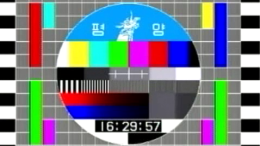
Late last year it’s testcard (pictured, right) was seen at the end of the international TV feed of the funeral procession for late leader Kim Jong Il.
While there hasn’t been much change at the facility in several years, the summer of 2011 appears to have brought a More >
Voice of Korea still having problems staying on-air
Mar 28th
Voice of Korea, the DPRK’s international shortwave radio broadcaster, is still having technical problems that result in entire broadcasts failing to make it on-air.
The problems began just over a month ago when some Voice of Korea broadcasts failed to appear at their scheduled times.
Now, a month later, the broadcaster is still failing to match its schedule. Today, on March 27, some of the scheduled transmissions were heard but others were missing.
Here’s a clip from a broadcast on March 20 when, midway through a piece of music the transmitter suddenly goes off air.
http://www.northkoreatech.org/wp-content/uploads/2012/03/1203201000-6285-txcutoff-edit.mp3It was due to remain on air for several additional More >